

Local rankings – factors, optimization and tracking
The presumed intent behind a search query is crucial for Google in determining rankings. For example, many users use Google Search to navigate Reddit.
However, about 46% of all search queries have a local intent. This means that users are usually looking for a doctor or a restaurant, for example, in their immediate vicinity or at least within a specific regional area.
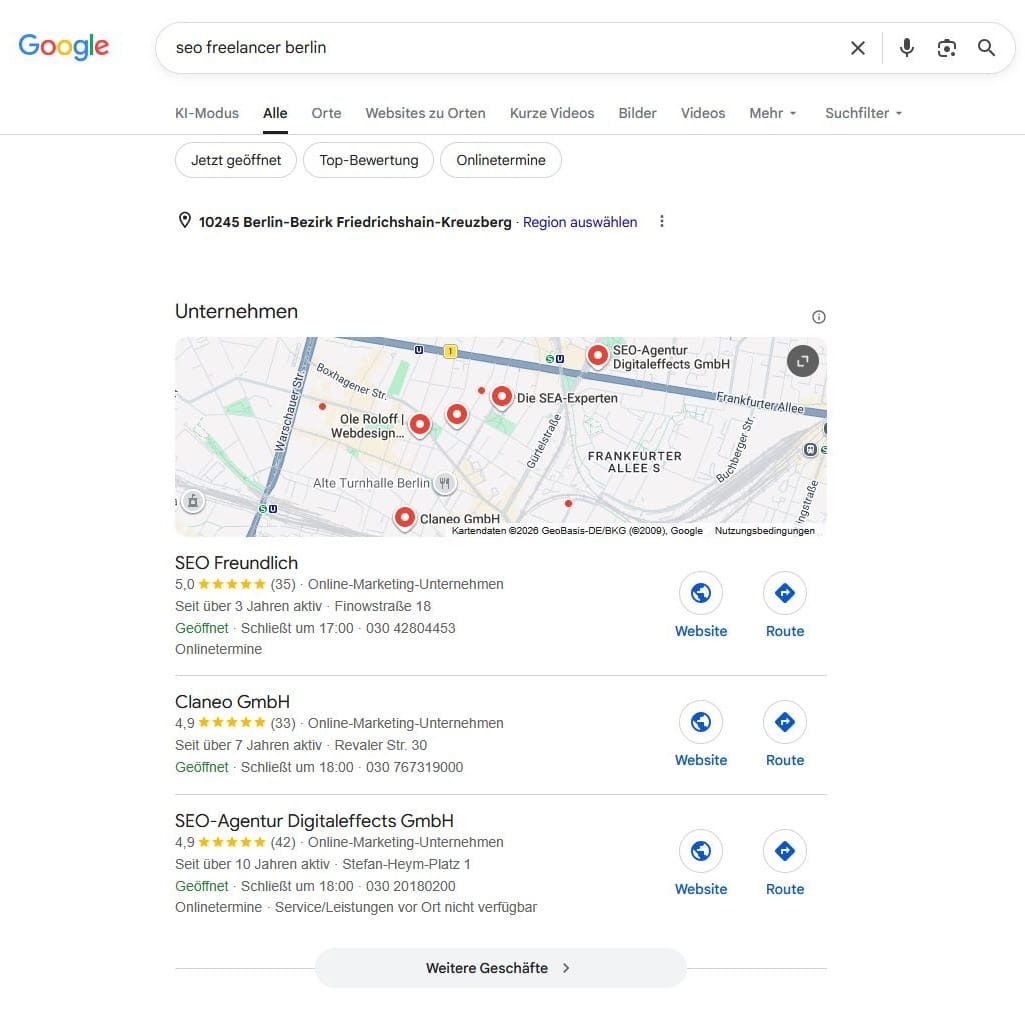
That’s why the rankings of local service providers and retailers can vary significantly depending on the location of the search query. This gives rise to unique requirements for local SEO.
Above all, however, it offers a major advantage over the competition. I had already analyzed the current state of the art in Germany in this regard in my study on the use of structured data for local SEO.
Even small and medium-sized businesses can relatively easily carve out a spot in the search engine spotlight through local rankings. In this post, I’ve taken a closer look at the key factors for optimization.
What factors influence local rankings?
Google itself publishes official explanations of the factors that influence local rankings. However, it is important to distinguish between Google My Business profiles (Google Maps) and web search results (“ten blue links”).
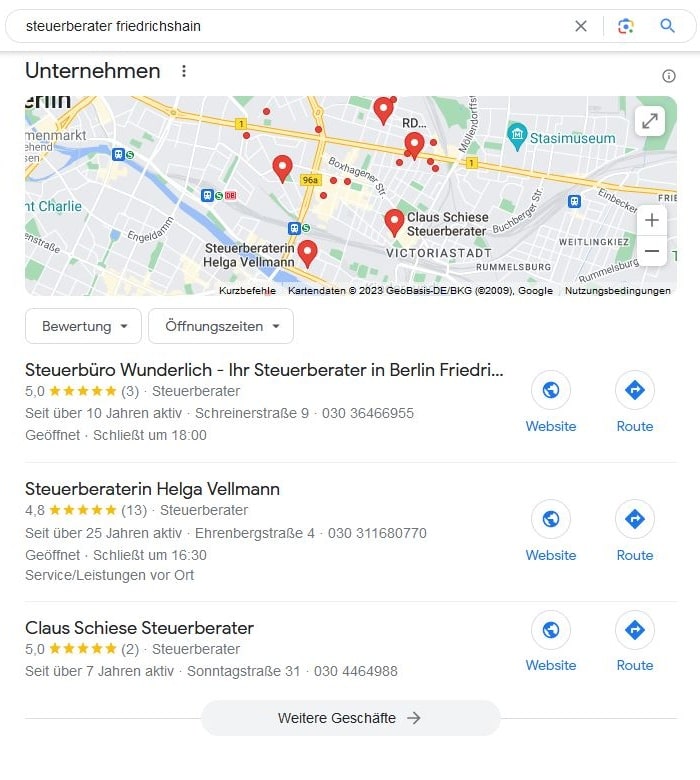
Google My Business profiles (Google Maps)
When it comes to the factors that influence local rankings of profiles on Google Maps, Google focuses on three key points:
- Relevance – “Relevance” is a quantifiable concept for search engines. That’s why profiles should be filled out as thoroughly and completely as possible. This gives Google’s machine-learning algorithms more content to analyze. In addition, this provides more—and potentially particularly well-suited—opportunities to appear prominently in the results for a search query.
- Distance – The distance to the service provider or retailer is, of course, of central importance for local rankings: Search engine users often type a location, such as “in Friedrichshain,” into the search bar in addition to the main search term. The search engine can then match those terms with potential results. Alternatively, Google can also calculate the distance between the searcher’s location and the location of, for example, a “tax advisor in Friedrichshain.”
- Popularity/Significance – Despite all efforts to personalize search results, Google always presents results based on an assumed average user: When in doubt, John Doe is more likely to be interested in a high-profile exhibition on Berlin’s Museum Island than in a small studio somewhere in Brandenburg. That’s why the level of recognition is also very important when optimizing for Google Maps. For Google My Business, the number and average rating of reviews are the primary factors used.
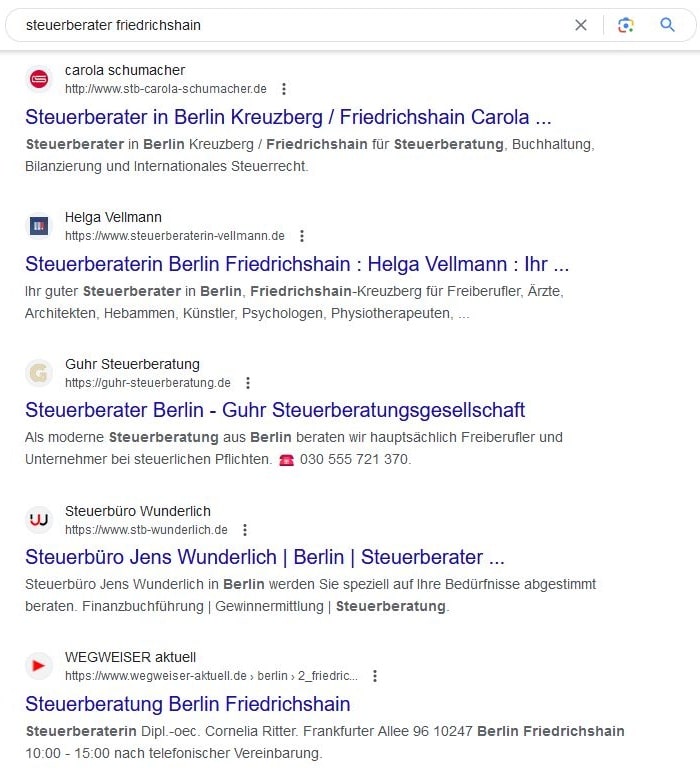
Localized Web Search Results
It is consistent with typical search behavior that users not only type a main term into the search bar but also specify a location—for example, “tax advisor Friedrichshain.” For Google, this results in (at least) two ways to address such a search query with relevant results:
- Keywords – Google can check whether a combination of the terms “tax advisor” and “Friedrichshain” appears on websites. Ideally, such combinations should already be explicitly mentioned in the meta title and the H1 tag, as precisely as possible. In addition, the keywords should appear in the body text. Other common places to include keywords are file names and image alt text. Given the ever-growing importance of videos, relevant terms should also appear in them and then be posted as transcripts on the website.
- Localization – Beyond purely conceptual web searches, Google attempts to determine the location of service providers and retailers. This can be done based on addresses provided in the legal notice, in the website’s source code, or in business directories. In addition, Google also uses movement profiles, for example. Based on this information, the distance between the location of a search query and the location of the tax advisor in Friedrichshain mentioned as an example can then be calculated.
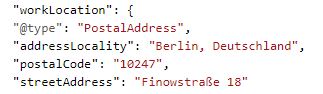
Here is an example of a snippet that I, as an SEO freelancer, use myself to localize this website:
How does Local Rank Tracking work?
Most tools do not include a feature for specific locations when running standardized ranking queries. Of course, there are economic reasons for this, as such analyses are much more data-intensive.
In practice, however, potential customers tend to send their inquiries from specific locations. That is why there is still a very high level of interest in this kind of information.
As part of premium features, there are now several offerings based on VPN solutions, particularly for rankings in Google Maps. One very interesting finding is that measurable changes in ranking can occur as frequently as every few hundred meters.
How do you optimize for local search?
Official Tips for Google My Business
Google officially provides some tips for optimizing Google My Business. The reason is that Google naturally wants to present users of local search with profiles on Google Maps that are as well-maintained as possible.
- Complete Data – Businesses with up-to-date, accurate, and complete information are more likely to be matched with relevant search queries. This kills two birds with one stone: On the one hand, the algorithms can analyze more data for interpretation, and on the other hand, it provides a starting point for delivering relevant search results.
- Locations – Verify your locations so they’re more likely to appear in local search results on Google services such as Maps and Search.
- Hours of Operation – Be sure to note special opening hours for holidays and keep all information up to date. If a customer finds the doors closed, Google will view this very negatively.
- Reviews – You should read, take note of, and respond to reviews to show that you are taking the feedback into account. High-quality reviews can also increase visibility.
- Photos & Products – Visual elements make profiles more visually appealing. In addition, brick-and-mortar stores, for example, can showcase their products online to give potential customers a preview of what they have to offer.
How to Boost Your Local SEO with Reviews and Ratings
Reviews and ratings are important signals for local SEO that influence both Google and potential customers. They demonstrate your credibility and quality and can give you a competitive advantage.
Example: If you own a hair salon in Munich, you can ask your satisfied customers to leave you a positive review on Google or other platforms. This will help you improve your ranking and build more trust with new customers.
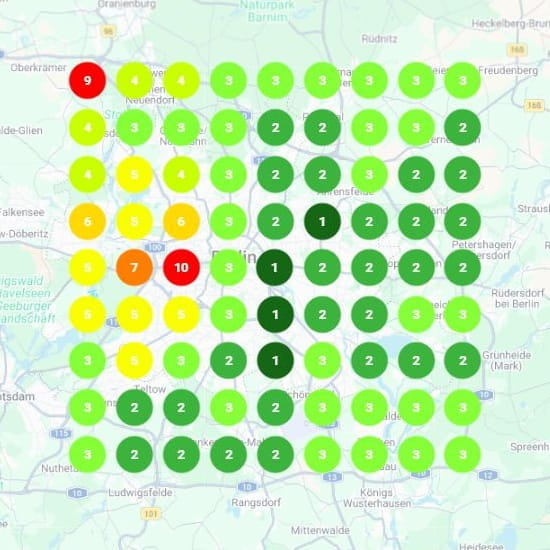
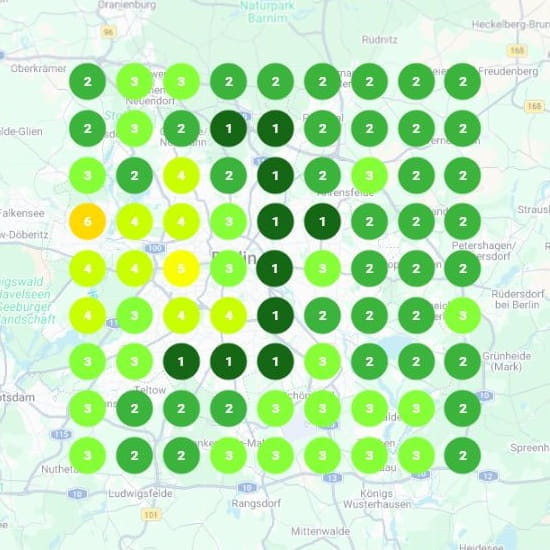
As an SEO freelancer, I’ve been very successful at generating positive reviews. That’s why I have a certain “dominance” over Berlin on Google Maps. These two screenshots show the trend from March 2026 to June 2026.
Implementation on Websites Using schema.org
The tips for optimizing GMB profiles for local search can be applied conceptually to websites using structured data. Technically, this approach actually offers many more possibilities, because these scripts free you from the limitations of the Google My Business user interface.
In addition, businesses can use structured data on their own websites to present services and products—in a machine-readable format—that cannot be listed in GMB due to youth protection regulations, for example. This is particularly relevant for retailers of alcohol and tobacco products, as well as for adult entertainment establishments.